Jekyll2023-12-20T09:38:38+00:00https://cc.isel.pt/feed.xmlCCISELCCISEL web siteEnhancing SSR in Low-Thread Web Servers2023-11-24T00:00:00+00:002023-11-24T00:00:00+00:00https://cc.isel.pt/java/2023/11/24/miguel-enhancing-ssr<p>Naive server-side rendering (SSR) techniques require a dedicated server thread
per HTTP request, thereby limiting the number of concurrent requests to the
available server threads.
Furthermore, this approach proves impractical for modern low-thread servers like
WebFlux, VertX, and Express Node.js.
To achieve progressive rendering, asynchronous data models provided by
non-blocking APIs must be utilized.
Nevertheless, this method can introduce undesirable interleaving between
template view processing and data access, potentially resulting in malformed
HTML documents.
Some template engines offer partial remedies through specific templating
dialects, but they encounter two limitations.
Firstly, their compatibility is confined to specific types of asynchronous APIs,
such as the reactive stream Publisher API.
Secondly, they typically support only a single asynchronous data model at a
time. In this research, we propose an alternative web templating approach that
embraces any asynchronous AP I (e.g., Publisher, promises, suspend functions,
flow, etc.) and allows for multiple asynchronous data sources.
Our approach is implemented on top of HtmlFlow, a Java-based DSL for writing
type-safe HTML. We evaluated against state-of-the-art reactive servers,
specifically WebFlux, and compared it with popular templating idioms like
Thymeleaf and KotlinX.html.
Our proposal effectively overcomes the limitations of existing approaches.</p>
<p><a href="https://www.scitepress.org/Link.aspx?doi=10.5220/0012165300003584" target="_blank">
<img src="/assets/blog/2023-11-24-miguel-enhancing-ssr.png" width="100%" />
</a></p>{"login"=>"miguelgamboa", "email"=>nil, "display_name"=>"Miguel Gamboa", "image"=>"miguel.jpg", "role"=>"Software Developer"}Naive server-side rendering (SSR) techniques require a dedicated server thread per HTTP request, thereby limiting the number of concurrent requests to the available server threads. Furthermore, this approach proves impractical for modern low-thread servers like WebFlux, VertX, and Express Node.js. To achieve progressive rendering, asynchronous data models provided by non-blocking APIs must be utilized. Nevertheless, this method can introduce undesirable interleaving between template view processing and data access, potentially resulting in malformed HTML documents. Some template engines offer partial remedies through specific templating dialects, but they encounter two limitations. Firstly, their compatibility is confined to specific types of asynchronous APIs, such as the reactive stream Publisher API. Secondly, they typically support only a single asynchronous data model at a time. In this research, we propose an alternative web templating approach that embraces any asynchronous AP I (e.g., Publisher, promises, suspend functions, flow, etc.) and allows for multiple asynchronous data sources. Our approach is implemented on top of HtmlFlow, a Java-based DSL for writing type-safe HTML. We evaluated against state-of-the-art reactive servers, specifically WebFlux, and compared it with popular templating idioms like Thymeleaf and KotlinX.html. Our proposal effectively overcomes the limitations of existing approaches.Kotlin scope functions2021-09-13T00:00:00+00:002021-09-13T00:00:00+00:00https://cc.isel.pt/kotlin/2021/09/13/felix-kotlin-scope-functions<p><a href="https://kotlinlang.org/docs/scope-functions.html">Kotlin scope functions</a> allow the execution of code blocks in a <em>richer</em> scope, typically with the end goal of making code simpler to write and read.</p>
<p>There are five different scope functions: <code class="language-plaintext highlighter-rouge">let</code>, <code class="language-plaintext highlighter-rouge">also</code>, <code class="language-plaintext highlighter-rouge">with</code>, <code class="language-plaintext highlighter-rouge">apply</code>, and <code class="language-plaintext highlighter-rouge">run</code>.
They all receive an object and a code block that will have access to that object.</p>
<p>The <code class="language-plaintext highlighter-rouge">with</code> function is the only one that receives the object as a regular parameter.
That leaves us with four remaining functions, which can be neatly organized in a two by two table, according to the two differentiating aspects:</p>
<ul>
<li>
<p>How is the object made available to the block - via <code class="language-plaintext highlighter-rouge">this</code> or via the lambda’s parameter.</p>
</li>
<li>
<p>What is the scope function’s evaluation result - the received object or the block’s evaluation result.</p>
</li>
</ul>
<p><img src="/assets/blog/2021-09-13-felix-kotlin-scope-functions.jpg" width="100%" /></p>
<p>For instance, <code class="language-plaintext highlighter-rouge">apply</code> provides the context object via <code class="language-plaintext highlighter-rouge">this</code> and evaluates to the context object.
This means that the following expression’s evaluation</p>
<div class="language-plaintext highlighter-rouge"><div class="highlight"><pre class="highlight"><code>someObject.apply {
someMethod()
}
</code></pre></div></div>
<ul>
<li>Calls <code class="language-plaintext highlighter-rouge">someMethod</code> on <code class="language-plaintext highlighter-rouge">someObject</code> (<code class="language-plaintext highlighter-rouge">this</code> is used implicitly).</li>
<li>Evaluates to <code class="language-plaintext highlighter-rouge">someObject</code>.</li>
</ul>
<p>The table above can be used to select the most appropriate scope function for a given use case.
Just answer these two questions and use them to select the table’s column and row, respectively:</p>
<ul>
<li>To what should the overall expression evaluate (i.e. is the action result needed or not)?</li>
<li>How should the context object be made available inside the block? Typically, when calling methods on the context object the most ergonomic way is via <code class="language-plaintext highlighter-rouge">this</code>.</li>
</ul>
<p>Finally, in addition to the previous five scope functions, there is also a <code class="language-plaintext highlighter-rouge">run</code> overload that doesn’t receive any object and essentially allows a block to be used as an expression.</p>{"login"=>"pmhfelix", "email"=>nil, "display_name"=>"Pedro Félix", "image"=>"felix.jpg", "role"=>"Software Developer"}Kotlin scope functions allow the execution of code blocks in a richer scope, typically with the end goal of making code simpler to write and read.Deconstructing yield Operator to Enhance Streams Processing2021-07-29T00:00:00+00:002021-07-29T00:00:00+00:00https://cc.isel.pt/programming/2021/07/29/deconstructing-yield<p>The <em>yield</em> keyword is a well-known feature in most programming languages to pause and resume generator functions.
Yet, what is the performance overhead of interleaving a <em>yield</em>-based operation in streams processing?
In this work, we analyze the intrinsic costs of using <em>yield</em> on user-defined operations and we compare it with other state-of-the-art alternatives, including our proposal of a functional and minimalistic yield-based design named <a href="https://github.com/tinyield/jayield">tinyield</a>.</p>
<p><a href="https://www.scitepress.org/PublicationsDetail.aspx?ID=sFFvNu0PTDs=&t=1" target="_blank">
<img src="/assets/blog/2021-07-29-deconstructing-yield.png" width="100%" />
</a></p>{"login"=>"dpoeira", "email"=>"dpoeira@cc.isel.ipl.pt", "display_name"=>"Diogo Poeira", "image"=>"dpoeira.jpg", "role"=>"Software Engineer"}dpoeira@cc.isel.ipl.ptThe yield keyword is a well-known feature in most programming languages to pause and resume generator functions. Yet, what is the performance overhead of interleaving a yield-based operation in streams processing? In this work, we analyze the intrinsic costs of using yield on user-defined operations and we compare it with other state-of-the-art alternatives, including our proposal of a functional and minimalistic yield-based design named tinyield.Bit aites - 012021-05-20T00:00:00+00:002021-05-20T00:00:00+00:00https://cc.isel.pt/programming/2021/05/20/palbp-bitaites-ep1-alex<p>Troca de bitaites entre dois professores do ISEL e dois dos seus ex-alunos.
Nesta conversa, recheada de divagações e de descontração, foram abordados
diversos temas relacionados com a área de engenharia de software.
Falou-se da experiência de ir trabalhar para fora de Portugal, do que consiste o
trabalho de um engenheiro de software, a importância do mestrado, os intervalos
salariais em Portugal, a diferença entre salários de Portugal e Suécia, os
ambientes de desenvolvimento, as soluções low code e o ciclo de feedback no
desenvolvimento de software.
Trata-se sobretudo de uma conversa de café onde se trocam uns quantos bitaites
acerca da experiência pessoal dos intervenientes.</p>
<p><a href="https://www.youtube.com/watch?v=q1Kqt0QAluk" target="_blank">
<img src="/assets/blog/2021-05-20-palbp-bitaites-ep1-alex.png" width="350px" />
</a></p>
<p>Alguns dos temas da conversa:</p>
<ul>
<li>00:00 - Os bitaites começam</li>
<li>07:00 - Trabalhar fora de Portugal</li>
<li>10:00 - Utilização escassa de programação funcional</li>
<li>17:05 - O que é isso de ser engenheiro de software?</li>
<li>24:15 - Importância do mestrado</li>
<li>41:00 - O que é que custou mais na hora da saída</li>
<li>44:00 - Discussão sobre o talento que sai de Portugal</li>
<li>49:00 - Diferença de salários Portugal-Suécia</li>
<li>59:00 - Erlang</li>
<li>1:08:00 - Ambiente de desenvolvimento</li>
<li>1:18:00 - Soluções low code</li>
<li>1:24:00 - Ciclo de feedback</li>
<li>1:41:00 - Ranges salariais</li>
</ul>{"login"=>"palbp", "email"=>"palbp@cc.isel.ipl.pt", "display_name"=>"Paulo Pereira", "image"=>"palbp.jpg", "role"=>"Software Engineer"}palbp@cc.isel.ipl.ptTroca de bitaites entre dois professores do ISEL e dois dos seus ex-alunos. Nesta conversa, recheada de divagações e de descontração, foram abordados diversos temas relacionados com a área de engenharia de software. Falou-se da experiência de ir trabalhar para fora de Portugal, do que consiste o trabalho de um engenheiro de software, a importância do mestrado, os intervalos salariais em Portugal, a diferença entre salários de Portugal e Suécia, os ambientes de desenvolvimento, as soluções low code e o ciclo de feedback no desenvolvimento de software. Trata-se sobretudo de uma conversa de café onde se trocam uns quantos bitaites acerca da experiência pessoal dos intervenientes.Towards unopinionated Web templates2021-05-07T00:00:00+00:002021-05-07T00:00:00+00:00https://cc.isel.pt/java/2021/05/07/miguel-towards-unopinionated-web-templates<p>In this article, Miguel Gamboa et al. argue against the use of an external DSL
to implement HTML templates, such as using JSP, handlebars, Thymeleaf, Vue, or
others, that introduce new dialects such as <code class="language-plaintext highlighter-rouge">th:each</code>, <code class="language-plaintext highlighter-rouge">th:with</code>, <code class="language-plaintext highlighter-rouge">v-for</code>,
<code class="language-plaintext highlighter-rouge">v-if</code>, <code class="language-plaintext highlighter-rouge">v-bind</code>, etc… On the other hand, an internal DSL like React JSX,
KotlinX.html, or HtmlFlow, let you fluently interleave constructs from the host
language (i.e. JavaScript, Kotlin, or Java, respectively) with the use of HTML.</p>
<p>Providing templating features through specific dialects incur the following drawbacks:</p>
<ol>
<li>weak or absent compile-time validation.</li>
<li>idiomatic mix between HTML, template dialects and the host programming language.</li>
<li>restricted suite of control flow features leveraged by template dialects.</li>
<li>opinionated templating idioms.</li>
<li>lack of asynchronous rendering support, according to asynchronous view models.</li>
</ol>
<p>This work shows how an internal domain-specific language (DSL) for HTML (such as
HtmlFlow, Kotlinx.html, or React JSX) can suppress the aforementioned
limitations.
To that end, this work uses the Spring Framework and the well-known sample
application PetClinic to show how an internal DSL for HTML provides
unopinionated web templates with boundless resolving features only ruled by the
host programming language (such as Java, Kotlin, or JavaScript).</p>
<p><a href="https://gamboa.pt/img/my-papers/lnbip2020-unopinionated-templates.pdf">
<img src="/assets/blog/2021-05-07-miguel-towards-unopinionated-web-templates.png" width="650px" />
</a></p>{"login"=>"miguelgamboa", "email"=>nil, "display_name"=>"Miguel Gamboa", "image"=>"miguel.jpg", "role"=>"Software Developer"}In this article, Miguel Gamboa et al. argue against the use of an external DSL to implement HTML templates, such as using JSP, handlebars, Thymeleaf, Vue, or others, that introduce new dialects such as th:each, th:with, v-for, v-if, v-bind, etc… On the other hand, an internal DSL like React JSX, KotlinX.html, or HtmlFlow, let you fluently interleave constructs from the host language (i.e. JavaScript, Kotlin, or Java, respectively) with the use of HTML.Corrotinas Kotlin, com Pedro Félix2021-03-01T00:00:00+00:002021-03-01T00:00:00+00:00https://cc.isel.pt/concurrent%20programming/2021/03/01/palbp-talking-kotlin-coroutines-with-pfelix<p>Está publicada no YouTube a gravação da conversa entre o Paulo Pereira e o Pedro Felix acerca do suporte Kotlin para corrotinas. O Pedro Félix fala da motivação para o seu uso e descreve as principais características do modelo de programação resultante.</p>
<p>Durante a conversa o Pedro Félix dá resposta às seguintes questões:</p>
<ul>
<li>Qual a relevância das corrotinas Kotlin? Que problema pretendem resolver? <a href="https://www.youtube.com/watch?v=K_fqNQz3UoU&list=PL8XxoCaL3dBhrsR7Sf4tVxOLCdrzfWTvG&index=1&t=4s">00:04</a></li>
<li>Qual a relação entre corrotinas, threads, fibras ou outras construções análogas? <a href="https://www.youtube.com/watch?v=K_fqNQz3UoU&list=PL8XxoCaL3dBhrsR7Sf4tVxOLCdrzfWTvG&index=1&t=354s">05:54</a></li>
<li>Qual a relação entre corrotinas e suspending functions? <a href="https://www.youtube.com/watch?v=K_fqNQz3UoU&list=PL8XxoCaL3dBhrsR7Sf4tVxOLCdrzfWTvG&index=1&t=890s">14:50</a></li>
<li>Como são executadas as corrotinas? <a href="https://www.youtube.com/watch?v=K_fqNQz3UoU&list=PL8XxoCaL3dBhrsR7Sf4tVxOLCdrzfWTvG&index=1&t=1716s">28:36</a></li>
<li>O custo da suspensão da corrotina é comparável ao custo da suspensão da thread? <a href="https://www.youtube.com/watch?v=K_fqNQz3UoU&list=PL8XxoCaL3dBhrsR7Sf4tVxOLCdrzfWTvG&index=1&t=2055s">34:15</a></li>
<li>O uso de corrotinas implica o uso de sincronização? <a href="https://www.youtube.com/watch?v=K_fqNQz3UoU&list=PL8XxoCaL3dBhrsR7Sf4tVxOLCdrzfWTvG&index=1&t=2684s">44:44</a></li>
<li>Os benefícios do uso de corrotinas no servidor e no cliente são os mesmos? <a href="https://www.youtube.com/watch?v=K_fqNQz3UoU&list=PL8XxoCaL3dBhrsR7Sf4tVxOLCdrzfWTvG&index=1&t=3355s">55:55</a></li>
<li>Quais são os principais elementos do modelo de programação disponibilizado? <a href="https://www.youtube.com/watch?v=K_fqNQz3UoU&list=PL8XxoCaL3dBhrsR7Sf4tVxOLCdrzfWTvG&index=1&t=3509s">58:29</a></li>
<li>Como se pode conciliar o modelo de programação das corrotinas com o uso de APIs assíncronas clássicas? <a href="https://www.youtube.com/watch?v=K_fqNQz3UoU&list=PL8XxoCaL3dBhrsR7Sf4tVxOLCdrzfWTvG&index=1&t=4204s">1:10:04</a></li>
<li>Porque se diz que nas corrotinas Kotlin a concorrência é, por desenho, explícita? <a href="https://www.youtube.com/watch?v=K_fqNQz3UoU&list=PL8XxoCaL3dBhrsR7Sf4tVxOLCdrzfWTvG&index=1&t=5420s">1:30:20</a></li>
<li>O que se entende por concorrência estruturada? <a href="https://www.youtube.com/watch?v=K_fqNQz3UoU&list=PL8XxoCaL3dBhrsR7Sf4tVxOLCdrzfWTvG&index=1&t=5945s">1:39:05</a></li>
</ul>
<p>Epílogo da conversa <a href="https://www.youtube.com/watch?v=K_fqNQz3UoU&list=PL8XxoCaL3dBhrsR7Sf4tVxOLCdrzfWTvG&index=1&t=7955s">2:12:35</a></p>{"login"=>"palbp", "email"=>"palbp@cc.isel.ipl.pt", "display_name"=>"Paulo Pereira", "image"=>"palbp.jpg", "role"=>"Software Engineer"}palbp@cc.isel.ipl.ptEstá publicada no YouTube a gravação da conversa entre o Paulo Pereira e o Pedro Felix acerca do suporte Kotlin para corrotinas. O Pedro Félix fala da motivação para o seu uso e descreve as principais características do modelo de programação resultante.Bluetooth module to enhance an Android App2021-02-03T00:00:00+00:002021-02-03T00:00:00+00:00https://cc.isel.pt/embedded%20systems/2021/02/03/patri-monitoring-hives-ble-and-android-app<p>The Bluetooth Low Energy (BLE) module integration in the equipment enhanced the functional characteristics to a richer and more interesting level than those achieved in previous versions to this integration. This integration also motivated the development of an Android App that revolutionized the interaction with the equipment. This post presents the integration result of this module in terms of hardware and the interaction achieved with Android App.</p>
<h2 id="motivation">Motivation</h2>
<p><a href="https://cc.isel.pt/embedded%20systems/2020/12/20/patri-monitoring-hives-test-with-bees-colony/">The experience carried out in real environment</a> demonstrated the relevance of being able to configure the equipment remotely, that is, to have the ability to establish a short distance and wireless connection between the equipment and the device that configures it. The device that configures the equipment corresponds to a mobile phone that is paired with the equipment at an early stage of configuration. The technology selected to establish a short distance and wireless connection was the Bluetooth technology, more specifically Bluetooth Low Energy (BLE).</p>
<p>This technology has been selected because it is present in most smartphones, communicates by radio frequency not requiring the equipment to be in line of view, supports connections up to 10 meters and is low consumption. Other technologies, such as Near Field Connection (NFC), Infrared or WIFI, conditionate the desired operability in different aspects. NFC technology requires a proximity of less than 1 meter, infrared requires that the equipment be in line of view and WIFI imposes a higher consumption than the consumption imposed with the BLE not introducing any additional advantage (assuming a direct connection between the equipment and the smartphone).</p>
<h2 id="hardware-solution">Hardware solution</h2>
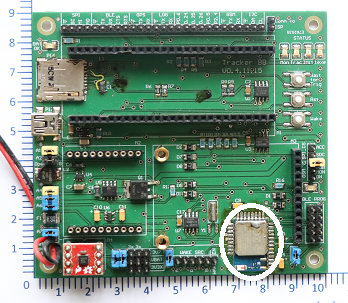
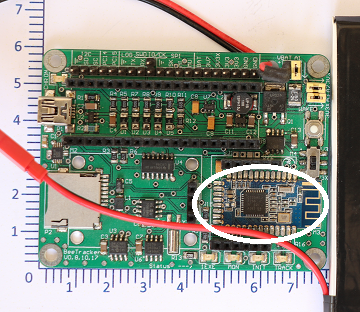
<p>The first TrackBees board to have integrated a BLE module was the V0.3 version, designed in August 2015. It used the <a href="https://www.silabs.com/wireless/bluetooth/bluegiga-low-energy-legacy-modules/device.ble112">BLE112 module</a> from Silicon Labs (at the time, that module implemented the BLE4.0 specification). From version V0.8 (October 2017) to the last developed version has been used the <a href="http://jnhuamao.cn/bluetooth.asp?id=1">HM-10 module</a> from Jinan Huamao Technology. The figures below present two versions, V0.4 and V0.8, each one with their respective BLE module highlighted (for illustration purposes, the microcontroller, GSM and GNSS modules are not mounted).</p>
<table>
<tr>
<td><img src="/assets/blog/2021-01-06-patri-monitoring-hives-post5-ble-and-android-app_TB_v0.4.png" width="250px" /></td>
<td><img src="/assets/blog/2021-01-06-patri-monitoring-hives-post5-ble-and-android-app_TB_v0.8.png" width="250px" /></td>
</tr>
</table>
<!---->
<p><a href="https://cc.isel.pt/embedded%20systems/2020/10/16/patri-monitoring-hives-battery-charge/">TrackBees solution consists of two subsystems</a> independently powered. The BLE module power is configured by a mechanical switch for subsystem one or subsystem two.</p>
<p>In subsystem one, the BLE module remains powered and, like the accelerometer and real time clock (RTC), may establish power supply of subsystem two. In the case of the BLE module, the power of subsystem two is established when a connection is made with the paired phone.</p>
<p>When powered into subsystem two, it is a component that plays a decisive role in interpreting the power activation of subsystem two: even if power was caused by the RTC or accelerometer, it corresponds to a configuration session if, during the control system initiation, a connection is established with the paired phone, otherwise it corresponds to a monitoring or a theft detection session.</p>
<p>Even if the BLE module power is managed by switch, it is expected that the usual configuration will be in subsystem two because of consumption reasons. Powering in subsystem one is essentially used to define first settings, testing purposes and other applications where autonomy is not a fundamental goal as it is in beehive application.</p>
<h2 id="android-app">Android App</h2>
<p><img src="/assets/blog/2021-01-06-patri-monitoring-hives-post5-ble-and-android-app-system-communication.png" alt="System generic view" title="System generic view" /></p>
<p>The BLE module integration in the equipment motivated the development of an <a href="https://github.com/jpatri/GuardTracker">Android App</a>. The first version of this App was developed during 2016. The Android App allows you to pair your phone with the equipment and configure it, both under BLE connections. The App also presents the data collected by the equipment in monitoring cycles and tracking sessions, received via SMS messages.</p>
<p>Initial pairing ensures that in the future the equipment only establishes Bluetooth connections with the paired phone. Along with this process, it is defined the phone contact to where the equipment must send SMS messages. After, you may change this contact and add a maximum of three different numbers. All defined contacts receive SMS messages.</p>
<p>The data received by SMS of a monitoring cycle corresponds so far to geographic position, battery charge, SIM card balance and temperature. This data is stored in the App in a database and presented by category. The geographical positions are displayed on a map and the other information is displayed in chart form (credits for <a href="https://weeklycoding.com/mpandroidchart-documentation/">MPAndroidChart</a>). At the time of writing this post, I have no examples of these screens.</p>
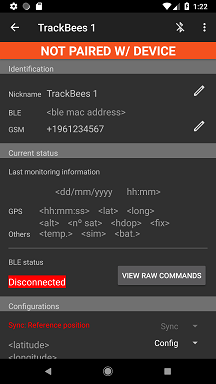
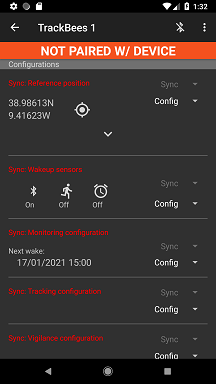
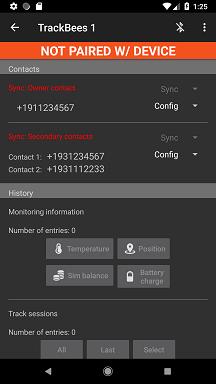
<p>The following images illustrate the current version of the App main page (with no paired equipment). The main page is divided into different sections, namely, identification of the equipment, current state, settings edition area, contacts and history.</p>
<table>
<tr>
<td><img src="/assets/blog/2021-01-06-patri-monitoring-hives-post5-ble-and-android-app_main1.png" width="200px" /></td>
<td><img src="/assets/blog/2021-01-06-patri-monitoring-hives-post5-ble-and-android-app_main2.png" width="200px" /></td>
<td><img src="/assets/blog/2021-01-06-patri-monitoring-hives-post5-ble-and-android-app_main3.png" width="200px" /></td>
</tr>
</table>
<!--
-->
<!--<img src="/assets/blog/2020-12-03-patri-monitoring-hives-post4-test-with-bees-colony-v06.png" width="350px">-->
<p>The Android App lets you configure several equipment settings. These may be done offline and become pending until they are synced via bluetooth to the equipment. Android App allows you to:</p>
<ul>
<li>Modify equipment reference position</li>
<li>Define which sensors may enable power supply of subsystem two (BLE, RTC and accelerometer)</li>
<li>Configure settings related to monitoring, tracking, and surveillance</li>
</ul>
<p>The ability to configure sensor activation, namely, the accelerometer, is of great help to install the equipment in the beehive since we can handle the equipment freely without starting a theft detection session.</p>
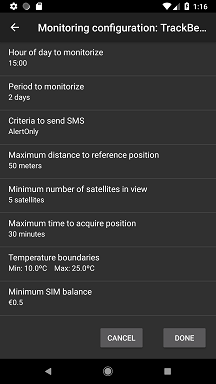
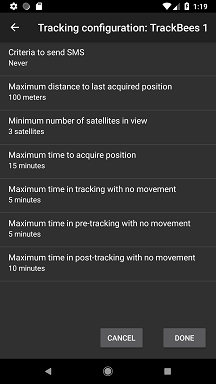
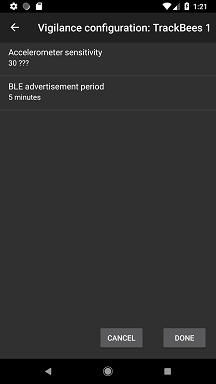
<p>The images below display the views to inspect and edit monitoring, tracking, and surveillance settings.</p>
<table>
<tr>
<td><img src="/assets/blog/2021-01-06-patri-monitoring-hives-post5-ble-and-android-app_mon.png" width="200px" /></td>
<td><img src="/assets/blog/2021-01-06-patri-monitoring-hives-post5-ble-and-android-app_track.png" width="200px" /></td>
<td><img src="/assets/blog/2021-01-06-patri-monitoring-hives-post5-ble-and-android-app_vig.png" width="200px" /></td>
</tr>
</table>
<!--  
-->
<p>At the monitoring level you may configure:</p>
<ul>
<li>The time of day to perform a monitoring cycle</li>
<li>The period based on the time settled above to perform a monitoring session</li>
<li>The criteria for sending SMS messages</li>
<li>The minimum difference from the current geographical position to the reference position to consider equipment moved</li>
<li>The minimum number of satellites in view to acquire geographical positions</li>
<li>The timeout to acquire a valid geographical position</li>
<li>Valid temperature range.</li>
</ul>
<p>At the tracking level you may configure:</p>
<ul>
<li>The criteria for sending SMS messages</li>
<li>The minimum distance from the last position registered to consider position modified</li>
<li>The minimum number of satellites in view to acquire geographical positions</li>
<li>The timeout to acquire a valid geographical position</li>
<li>Three timeouts related to tracking sessions. The three timeouts set the maximum time without movement to update the state of the equipment control system. Tracking is divided into three phases: pre-tracking; tracking; and post-tracking. In the first phase, pre-tracking, the system considers an accelerometer false activation if timeout is reached without the equipment modifying its position. In this case, it returns to surveillance mode, silently. In the tracking phase, it is interpreted as stopping the equipment movement forcing the transition to the post-tracking phase. In the post-tracking phase, it returns to the tracking phase again if it gets a position change before timeout, otherwise, the system terminates the tracking session and transits to surveillance mode. In these two last phases, SMS messages are sent to the App with current positions depending on defined settings.</li>
</ul>
<p>At the surveillance level you may configure:</p>
<ul>
<li>The accelerometer sensitivity</li>
<li>The BLE module advertisement cycle that corresponds to BLE wake up period from sleep mode to try a Bluetooth connection</li>
</ul>
<p>Surveillance configurations are not yet supported by the device control system.</p>
<h2 id="conclusion">Conclusion</h2>
<p>The BLE module integration in the equipment and the Android App development made the user interface much more friendly, practical and interesting than the defined before this integration. Before this integration, the solution implemented for equipment pairing and configuring depends on SMS messages sent from the phone. In most cases, the feedback was not immediate providing some concern about operations success. Unlike, with bluetooth connection, feedback becomes immediate and, in addition, avoids the cost with SMS messages. During testing, I often got the feeling I was dealing with a gadget.</p>
<p>Next post: current version of the equipment and future directions.</p>{"login"=>"jpatri", "email"=>"jpatri@cc.isel.ipl.pt", "display_name"=>"João Pedro Patriarca", "image"=>"patri.jpg", "role"=>"Software Developer"}jpatri@cc.isel.ipl.ptThe Bluetooth Low Energy (BLE) module integration in the equipment enhanced the functional characteristics to a richer and more interesting level than those achieved in previous versions to this integration. This integration also motivated the development of an Android App that revolutionized the interaction with the equipment. This post presents the integration result of this module in terms of hardware and the interaction achieved with Android App.Can we teach Node Js without callbacks?2021-01-15T00:00:00+00:002021-01-15T00:00:00+00:00https://cc.isel.pt/web/2021/01/15/miguel-callbacks-yes-or-not<p>After another semester teaching Web Development, the following question arises to
my mind: <em>can we teach Node Js without callbacks</em>?
Considering that we cannot avoid Promises and async/await, should we
continually introduce callbacks in the first place? Notice that:</p>
<ol>
<li>Most Node APIs already supports Promises, e.g. file system module <code class="language-plaintext highlighter-rouge">fs</code></li>
<li>It is increasingly difficult to find an HTTP client Node module that provides
callback-based API. For instance, one of those most used modules, i.e.
<code class="language-plaintext highlighter-rouge">request</code> (with 23M downloads/week) announced that is fully deprecated in
February of 2020.</li>
</ol>
<p>Of course, we can always use the standard <code class="language-plaintext highlighter-rouge">http</code> module of Node, yet its API is
far from being friendly.</p>
<p>Thus, this leads me to think that we could remove callbacks from the curricular
plan of the Web Development course. Can we?</p>
<p>Yet, some of the state-of-the-art frameworks for web development in the
Javascript ecosystem are still based on callbacks, namely: 1) express, 2)
passport. Of course there are a couple of wrapper alternatives that provide a
promise-based abstraction layer over these modules. But none of those approaches
was adopted as a best practice over the plain use of express or passport.</p>
<p>So, now regarding these latter points I will tend to consider that we should
also keep callbacks-based calling convention in the curricular plan of Web
Development course. Or not?</p>{"login"=>"miguelgamboa", "email"=>nil, "display_name"=>"Miguel Gamboa", "image"=>"miguel.jpg", "role"=>"Software Developer"}After another semester teaching Web Development, the following question arises to my mind: can we teach Node Js without callbacks? Considering that we cannot avoid Promises and async/await, should we continually introduce callbacks in the first place? Notice that: Most Node APIs already supports Promises, e.g. file system module fs It is increasingly difficult to find an HTTP client Node module that provides callback-based API. For instance, one of those most used modules, i.e. request (with 23M downloads/week) announced that is fully deprecated in February of 2020.Enhanced Streams Processing with Kotlin’s Sequence Interface?2021-01-15T00:00:00+00:002021-01-15T00:00:00+00:00https://cc.isel.pt/java/2021/01/15/miguel-kotlin-sequence<p>Using Java libraries in the Kotlin ecosystem is a well-known approach. Yet, does
it also apply in the opposite direction? I.e. Does it make sense to use a Kotlin
library in Java? Yes, it does. In the <a href="https://www.infoq.com/articles/enhanced-stream-kotlin-sequence/">article</a>,
Diogo Poeira and Miguel Gamboa show you why. Particularly, to suppress the
overheads and lack of operation in Java streams API.</p>
<p>Despite the ingenious conception behind the Java streams package, it is not
obvious how to efficiently extend its API with user-defined operations. Moreover
its API lacks many useful operations such as <em>distinctBy</em>, <em>zip</em>, <em>collapse</em>, and many
others. To suppress those limitations several state-of-the-art alternatives have
been adopted such as Eclipse Collections, jOOλ, StreamEx or Vavr, but all of
them have limitations either on performance or in extensibility or even both.</p>
<p>In their article titled “<a href="https://www.infoq.com/articles/enhanced-stream-kotlin-sequence/"><em>Enhanced Streams Processing with Kotlin’s Sequence Interface</em></a>”
Diogo and Miguel analyze the behavior of those libraries in a couple
of benchmarks in realistic use-cases and how Kotlin’s Sequence outperforms the
competition in a Java program.</p>{"login"=>"miguelgamboa", "email"=>nil, "display_name"=>"Miguel Gamboa", "image"=>"miguel.jpg", "role"=>"Software Developer"}Using Java libraries in the Kotlin ecosystem is a well-known approach. Yet, does it also apply in the opposite direction? I.e. Does it make sense to use a Kotlin library in Java? Yes, it does. In the article, Diogo Poeira and Miguel Gamboa show you why. Particularly, to suppress the overheads and lack of operation in Java streams API.Test in real environment2020-12-20T00:00:00+00:002020-12-20T00:00:00+00:00https://cc.isel.pt/embedded%20systems/2020/12/20/patri-monitoring-hives-test-with-bees-colony<p>The status reached in the TrackBees equipment allowed us to perform a test in a real operating environment. During 2015, the equipment was installed in a hive in full activity, that is, in a hive with a bee colony. This post presents the experience, conclusions and the consequences of performing this test. In fact, “the consequences” was the most relevant aspect that was obtained with this test.</p>
<h2 id="motivation">Motivation</h2>
<p>The TrackBees equipment in version v0.2 was subjected to <a href="https://cc.isel.pt/embedded%20systems/2020/11/29/patri-monitoring-hives-tests-on-version-2014/">several tests</a> with the goal of assessing the operability of the equipment. However, all these tests were performed in a managed environment, that is, they were either performed in the laboratory or outside but in an empty hive. Therefore, there were a number of unanswered questions, such as: would installation in a hive compromise bees activity? Would communications in a rural environment be compromised? Would the reading of the geographical position be affected by the fact that the equipment is installed inside the hive? It became mandatory to test the operability of the equipment in a real environment. And so it happened… on a weekend, visiting an apiary, the equipment was placed inside a hive with bees.</p>
<h2 id="preparation">Preparation</h2>
<p>A <a href="https://en.wikipedia.org/wiki/Langstroth_hive">traditional hive</a> consists of one, two, or three boxes depending on the size of the bee colony and on the honey production. The boxes are stacked vertically, and inside each box is installed a set of eight to ten frames. Typically, in the lowest box lies the queen and the brood and, in the boxes above, is where honey is produced and stored.</p>
<p>For the test, a frame was prepared to contain the equipment. The preparation consisted of removing the wire from the frame used to fix the beeswax, closing the frame with two panels to avoid direct contact of the bees with the equipment and fixing the equipment on one of the panels. The figure below illustrates the frame prepared with the equipment fixed.</p>
<p><img src="/assets/blog/2020-12-03-patri-monitoring-hives-post4-test-with-bees-colony-frame-w-device.png" alt="Frame with Trackbees device" title="Frame with Trackbees device" /></p>
<h2 id="experience">Experience</h2>
<p>The experience of putting the equipment into operation in a beehive with bees revealed dramatic. The working environment was adverse considering the number of bees around, the proper clothing that did not help handling the equipment, the need for rapid intervention to reduce the disturbance of hive activity and, mainly, the setup of putting the equipment into operation. For example, in the version used in the test, the geographic position used as reference is collected by the equipment the first time it is connected to the battery. Once collected, the device sends it by SMS to the paired phone before transitioning to surveillance mode. The time involved to obtain the geographical position for the first time is usually long and can reach to, by experiences, 30 minutes because it is a “cold” reading, that is, first, it needs to acquire signal with any satellite and receive the entire satellites <a href="https://www.e-education.psu.edu/geog862/node/1739">almanac</a> and, second, receive from four different satellites, at minimum, their <a href="https://www.e-education.psu.edu/geog862/node/1737">ephemeris</a>. So, all time corresponding to equipment initialization took place without realizing whether the equipment was operating properly, or not. By comparison, in the laboratory the equipment is connected to a terminal and directly observed the log messages produced by the equipment. In this reality, the same method to follow the initiation process was not possible because the equipment was closed inside a frame and installed inside a hive. However, it was done!</p>
<h2 id="conclusions-and-consequences">Conclusions and consequences</h2>
<p>After a few weeks in operation, it was observed that the bees maintained their normal activity, not accusing the presence of the equipment. When the frame with the equipment was removed from the hive it was verified only that the bees had sealed small holes and grooves of the frame with propolis not having interfered with the operation of the equipment. The equipment carried out the planned monitoring cycles by sending the collected data by SMS.</p>
<p>But the main aspect retained with this experience were the difficulties observed in the initial configuration of the equipment at the time of installation. This motivated the introduction of technology in the equipment to suppress the difficulties previously evidenced. This technological evolution had effects in both hardware and system control program.</p>
<p>A Bluetooth module for short-distance wireless communications has been added to the solution. With the addition of this module, the total configuration of the equipment began to be performed by Bluetooth. The addition of this module also provided the integration of an Android application to configure the equipment by Bluetooth. The same App is used to present the data sent by the equipment via SMS.</p>
<p>The following image shows the equipment with version 0.6. In this version most components were transferred to the base board except for the microcontroller, GSM and GPS modules. This version already includes a Bluetooth module.</p>
<p><img src="/assets/blog/2020-12-03-patri-monitoring-hives-post4-test-with-bees-colony-v06.png" alt="Trackbees v0.6 board" title="Trackbees v0.6 board" />
<!--<img src="/assets/blog/2020-12-03-patri-monitoring-hives-post4-test-with-bees-colony-v06.png" width="350px">--></p>
<p>Next post: integration of BLE (Bluetooth Low Energy) module in TrackBees equipment.</p>{"login"=>"jpatri", "email"=>"jpatri@cc.isel.ipl.pt", "display_name"=>"João Pedro Patriarca", "image"=>"patri.jpg", "role"=>"Software Developer"}jpatri@cc.isel.ipl.ptThe status reached in the TrackBees equipment allowed us to perform a test in a real operating environment. During 2015, the equipment was installed in a hive in full activity, that is, in a hive with a bee colony. This post presents the experience, conclusions and the consequences of performing this test. In fact, “the consequences” was the most relevant aspect that was obtained with this test.